

THE FIVE POINTS
By Gregory Christiano
A brief commentary:
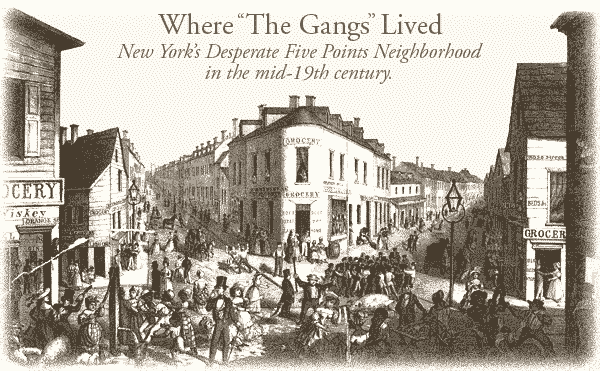
The name Five Points evokes images of poverty, rampant crime, decadence and despair. That’s true. The Five Points was a lurid geographical cancer filled with dilapidated and unlivable tenement houses, gang extortion, corrupt politicians, houses of ill-repute and drunkenness and gambling. This was a place where all manner of crime flourished, the residents terrorized and squalor prevailed. This is
the setting over many decades through the nineteenth century.
 |
||
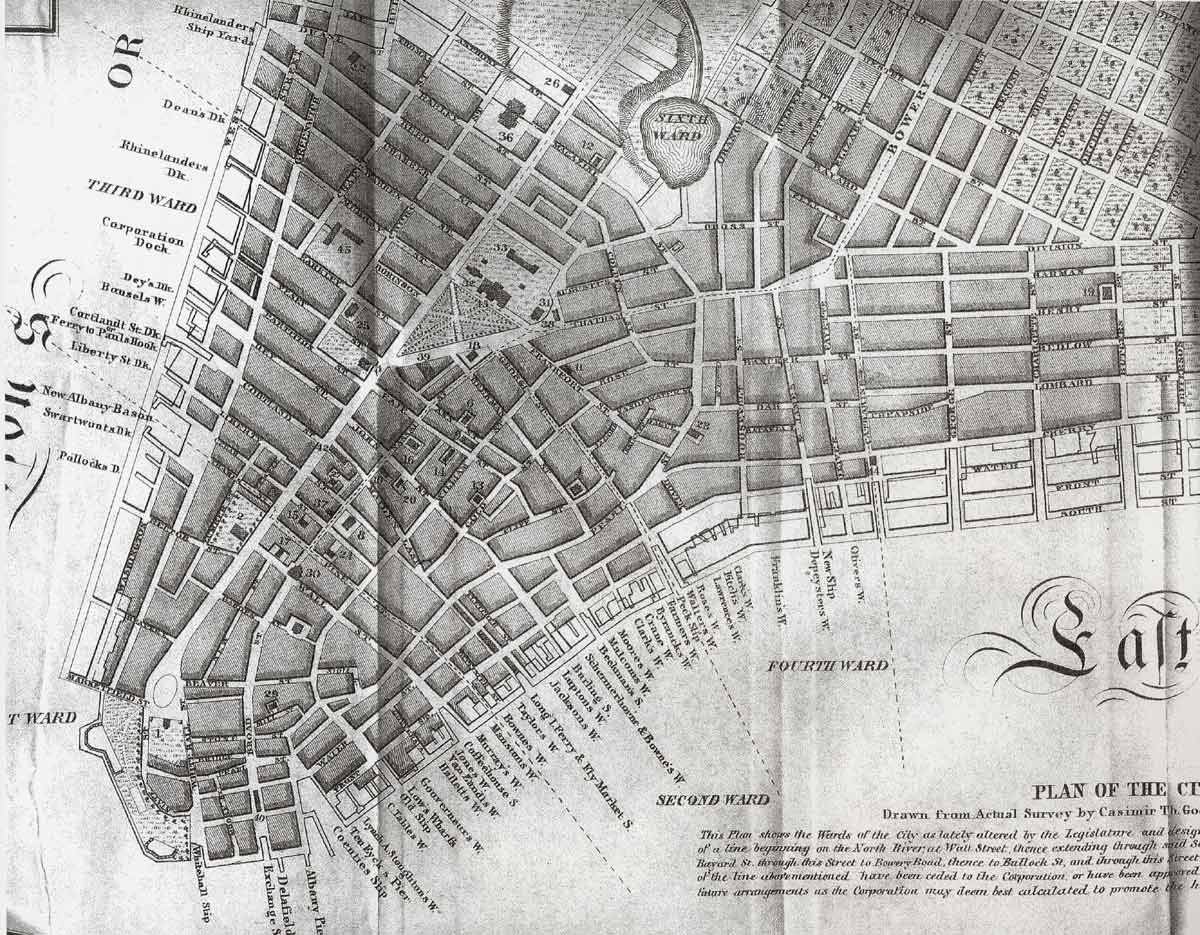
The district was known as the Sixth Ward bounded, south, by Reade Street; west, by West Street; north by Canal Street; east by Broadway. The Five Points so named in the 1830’s from the convergence of the intersection of five streets: Mulberry, Anthony (now Worth St.), Cross (now Park), Orange (now Baxter), and Little Water Street (no longer exists). This neighborhood was built over the Collect Pond and its adjacent swampland north of City Hall and the Courthouse, between Broadway and the Bowery. The scene is set.
Certain areas of Manhattan are not suitable to build tall structures because there is no bedrock underground. This was the case in the Canal Street area. If you look at the skyline from either west or east, you’ll notice how the tall buildings are clustered together whereas the skyline dips to smaller structures where there is no bedrock to support them. This is the reason.
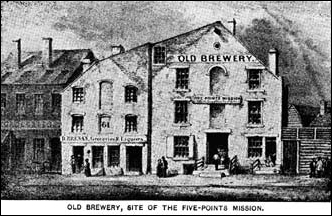
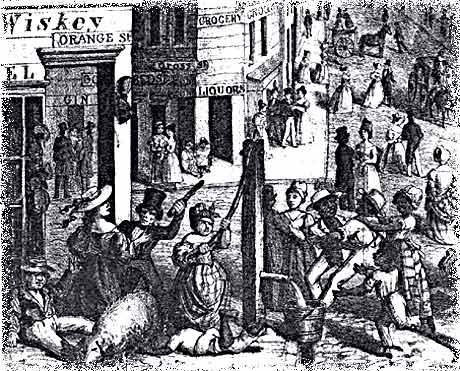
When the landfill started to decay in the 1820’s the wood frame houses began to tilt over and sink. It became infested with mosquitoes and disease; the decent residents moved out, those who remained became impoverished and victims of slum lords, gangs and ruthless politicians looking for easy votes. Personal safety was compromised and a person was in constant threat of being robbed or worse. Beginning with the “Old Brewery” – a building that was converted to an apartment house, the floors were partitioned into small flats, rented to the poor and seedy characters. Each room had whole families, cooking, eating, and sleeping in this one room. It was a ghastly sight with squalid living conditions. The same situation prevailed throughout the district – the lower floors usually for drinking, dancing, gambling, and riotous behavior. Many people were robbed, beaten or shanghaied. In the cellars (they were called “cellar dwellers”) were the “oyster saloons,” which were kept open all night luring fresh, unsuspecting victims. This neighborhood was a dangerous place to live in and visit.
The many dancehalls brought together the Irish and African-Americans who had a large population in the area. A combination of the Irish jig or reel and the African-American shuffle, created a new dance form – Tap Dancing. This became a popular trend and forever
was ingrained in American culture. As to stuffing the ballot boxes and stealing elections, this neighborhood became expert and notorious. After the Civil War, in particular, the Five Points (Sixth Ward) district had a reputation for casting more ballots than eligible voters!
 |
||
Over the decades the neighborhood changed. It was extremely bad in the 1830’s and ‘40’s until Protestant religious sects made inroads to clean up the area in the 1850’s. By 1860 Five Points was a little less violent, but still a slum. Abraham Lincoln visited the area in 1860 and reluctantly gave a speech to some school children. He as well as Charles Dickens, who visited the area in 1842, were appalled at the abject poverty and terrible living conditions. Conditions improved only to crumble again in the 1880’s with the influx of Italian and Chinese immigrants. By 1897 the area houses had been demolished and the district took on a whole new look.
Martin Scorsese’s current movie “The Gangs of New York,” captures the very essence of the period between 1846 and the draft riots of 1863 but it is more make-believe than history. (That’s Hollywood for you). Although there were rival gang melees it usually wasn’t on the scale depicted in the movie or as frequent. The characters were composites of historical figures, for instance, Bill “The Butcher” Cutter (Daniel Day- Lewis), the Protestant leader of the “Natives,” was actually Bill Poole who was assassinated in 1855 many years
before the draft riots. Wm. “Boss” Tweed (James Broadbent) was true to the character. Tweed put even the mafia to shame as the Sachem of Tammany Hall and the most corrupt politician in New York City history. All in all, the movie portrayed the times accurately, creating the proper atmosphere and showing the desperate plight of the free African-Americans already living there, and newly arriving immigrants hoping to find paradise only to be thrown into the harsh realities of racism, religious bigotry and rejection. The movie presented a great sense of what life was like in that part of town and how it differed from the uptown rich and middle class. To many uptown New Yorkers no one was “respectable” that came from the Five Points. But multi-ethnic America was borne out of that slum.
 |
||
By the turn of the twentieth century this neighborhood faded into memory. The very last scene in “The Gangs of New York” demonstrates how the city changed over the decades following these events and how memories were lost to time. Just like the graveyard with the changing city as a background. A great ending. And one with a strong lesson to be learned.
Let the following articles from the newspapers of the day speak for themselves. It’s hard to determine how much of these accounts are true or fabrications to sell newspapers. You must be the judge. The violence and living conditions are fact and most of the descriptions
that follow are rich in period history. In the Chinese proverb, it certainly was ‘interesting times’ to be living.
 |
||
________________________________
Recommended reading list:
“The Gangs of New York: An Informal History of the Underworld,” by Herbert Asbury, Jorge Luis (Forward).
“Five Points: The Nineteenth Century New York City Neighborhood that Invented Tap Dance Stole Elections and Became the Worlds Most Notorious Slum,” by Tyler Anbinder.
“Empire City: New York Through the Centuries,” Kenneth T. Jackson and David S. Dunbar, editors.
“Gotham: A History of New York City to 1898,” by Edwin Borrows and Mike Wallace.
“New York by Gas-Light and Other Urban Sketches,” by George G. Foster, edited and with an introduction by Stuart M. Blumin. Originally published in 1850, new edition 1990.
“The New Metropolis: New York City, 1840 – 1857,” by Edward K. Spann
“Immigrant Life in New York City, 1825-1863,” by Robert Ernst (1949)
©2003 The Composing Stack Inc. ©2003 Gregory J. Christiano